
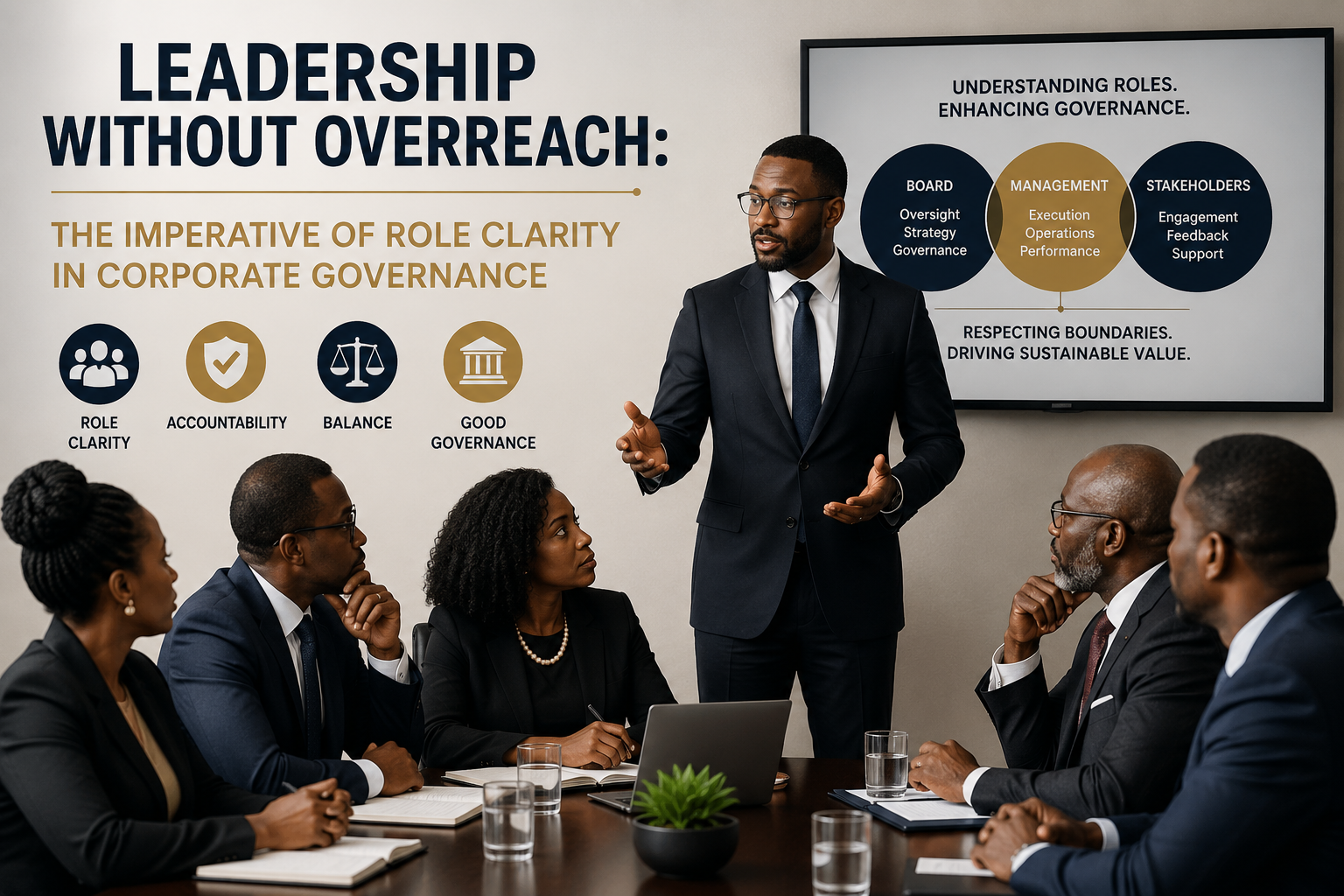
LEADERSHIP WITHOUT OVERREACH: THE IMPERATIVE OF ROLE CLARITY IN CORPORATE GOVERNANCE

pic2

Effective corporate governance rests fundamentally on a clear distinction between oversight and execution. Preserving this boundary strengthens accountability, sharpens strategic focus, enhances organizational resilience, and promotes sustainable long-term performance.

The contemporary business environment is increasingly complex and demanding. Geopolitical tensions, uneven economic growth, rapid technological disruption, evolving regulatory frameworks, and rising stakeholder expectations have placed boards under unprecedented scrutiny regarding how authority is exercised at the highest levels of organizations.

Against this backdrop, strong governance remains indispensable to organizational stability and competitiveness. Clearly defined leadership roles support sound decision-making, reduce institutional friction, reinforce accountability, and foster trust between governing bodies and executive management.

Recent international boardroom developments involving leadership transitions arising from governance concerns have further underscored the importance of maintaining clear boundaries between board oversight and executive authority. These developments bring into sharp focus a perennial governance question: where should board oversight end, and where should management authority begin? Addressing this question is essential to sustain effective governance systems, preserving accountability, and preventing the erosion of organizational discipline.

Understanding the Distinct Roles of the Board and Management

The board bears ultimate responsibility for governance, strategic direction, risk oversight, accountability, and the protection of stakeholder interests. It establishes the organization’s ethical tone, approves long-term priorities, oversees performance, and ensures that appropriate governance mechanisms remain effective.

Management, by contrast, is responsible for execution. Executives translate strategic intent into operational reality by managing day-to-day activities, allocating resources, leading people, and delivering agreed organizational objectives.

The chairman’s responsibility is to lead the board effectively by facilitating constructive deliberations, encouraging balanced contributions from directors, and maintaining discipline in decision-making processes. Importantly, this role does not extend to directing operational activities or supervising staff. Respect for this distinction strengthens institutional trust, clarifies accountability, and reinforces effective leadership throughout the organization.

Role clarity is therefore not merely an administrative requirement; it is a cornerstone of sound corporate governance. It preserves accountability, prevents overlapping authority, and promotes coherent leadership across the enterprise.

In well-governed organizations, the board exercises its oversight responsibilities primarily through the Chief Executive Officer (CEO), who serves as the critical interface between governance and management. Rather than engaging directly with subordinate executives or intervening in operational matters, the board provides strategic guidance, approves key policies, monitors performance, and holds the CEO accountable for organizational outcomes.

The CEO, in turn, assumes responsibility for leading the executive team and ensuring that operational activities align with the board’s strategic expectations. This governance architecture reinforces the distinction between oversight and execution, minimizes conflicting directives, promotes organizational discipline, and ensures that accountability remains clear and effective at every level.

When Oversight Becomes Interference

Oversight becomes interference when governance responsibilities shift from supervision to execution. Effective oversight requires boards to evaluate performance, challenge assumptions, review risks, and hold management accountable. Interference arises when directors or chairmen begin influencing operational decisions or circumvent established executive channels.

Common warning signs include direct engagement with operational personnel without executive approval, issuing instructions to management teams, or frequent involvement in matters that properly belong within executive authority. Another indication is the gradual erosion of clarity regarding decision rights among senior leaders because of repeated board intervention.

Such practices create confusion throughout the organization. Executives may become hesitant in exercising authority, uncertain about the limits of their responsibilities. Over time, accountability weakens as ownership of outcomes becomes increasingly diffused. The consequences are predictable: slower execution, reduced efficiency, weakened organizational discipline, and diminished strategic effectiveness.

These risks can be significantly mitigated through robust governance instruments. Board charters should clearly articulate responsibilities relating to strategy, oversight, risk governance, CEO appointment and evaluation, and policy approval. Similarly, well-defined delegations of authority, committee mandates, and structured management reporting frameworks establish clear boundaries between governance and management functions.

Collectively, these mechanisms prevent governance encroachment, reinforce accountability, and ensure that boards remain focused on their essential oversight role while management retains responsibility for operational execution.

Governance Risks of Chairman Overreach

When a chairman crosses into operational territory, significant governance risks emerge that can undermine organisational effectiveness and market confidence.

First, executive authority becomes weakened. Senior leaders may feel undermined, reducing confidence in decision-making and slowing execution. This often generates tension between governance structures and management teams, impairing organizational cohesion.

Second, board-management relationships may deteriorate. Trust remains the foundation of effective governance, and persistent interference inevitably erodes that trust. Once damaged, restoring productive collaboration can prove both difficult and time-consuming.

Third, reputational risks intensify. Investors and markets respond quickly to signs of governance instability. International experience demonstrates that leadership disruptions associated with governance concerns frequently generate investor uncertainty and adverse market reactions. Such responses reflect broader concerns regarding institutional stability, leadership effectiveness, and governance discipline.

Furthermore, strategic focus becomes fragmented. Boards that become preoccupied with operational details inevitably devote less attention to long-term priorities, enterprise risk management, succession planning, innovation, and future positioning.

Ultimately, stakeholder confidence suffers. Investors, employees, regulators, and business partners expect clarity in governance structures and accountability arrangements. When those boundaries become blurred, confidence in leadership stability and institutional integrity declines.

Lessons for Directors and Boards

Boards must take deliberate and sustained steps to preserve governance discipline and maintain healthy relationships with management.

Clear role definition remains the starting point. Board charters should explicitly define the responsibilities of the chairman, non-executive directors, board committees, and executive management.

Regular board evaluations are equally important. These assessments enable boards to determine whether directors continue to operate within appropriate governance boundaries while contributing effectively to strategic oversight.

Succession planning represents another critical pillar of governance stability. Well-designed leadership transition processes minimize uncertainty and ensure continuity across both board and executive structures.

Ethical leadership must underpin all board conduct. Respecting governance boundaries reflects institutional maturity and strengthens trust throughout the organization.

Constructive challenge remains an essential board responsibility; however, such challenge must focus on evaluation, inquiry, and supervision rather than operational execution. Directors should question assumptions, test management proposals, and scrutinize performance without assuming managerial functions.

Continuous learning is equally indispensable. As governance expectations evolve and business environments become increasingly complex, directors must remain informed about emerging practices, regulatory developments, and international governance standards.

Conclusion

Effective governance depends upon a disciplined separation between board oversight and management responsibility. The board exists to govern; management exists to execute strategy and deliver results.

The effectiveness of a chairman should never be measured by operational involvement but rather by the ability to lead the board, uphold governance standards, facilitate sound decision-making, and preserve institutional integrity. Respect for these boundaries strengthens trust, reinforces accountability, and supports sustainable organizational performance.

The lessons emerging from recent international governance developments are unequivocal: when the distinction between governance and management becomes blurred, organizational confidence, strategic focus, and market trust are placed at risk. Conversely, boards that preserve these boundaries are better positioned to navigate uncertainty, inspire investor confidence, and create enduring value for all stakeholders.

Research Unit

Department of Advocacy and Stakeholder Engagement

Chartered Institute of Directors Nigeria (CIoDN)

28, Olawale Edun Road (Formerly Cameron Road), Ikoyi, Lagos.

What do you think?
Read More

More Related News

What Every Board Should Learn Before the Regulator Acts

LEADERSHIP OVERSIGHT AND BOARD ACCOUNTABILITY:

Aligning Governance with Sustainability: Insights from Nigeria’s Regulatory Landscape

Effective corporate governance rests fundamentally on a clear distinction between oversight and execution. Preserving this boundary strengthens accountability, sharpens strategic focus, enhances organizational resilience, and promotes sustainable long-term performance.

The contemporary business environment is increasingly complex and demanding. Geopolitical tensions, uneven economic growth, rapid technological disruption, evolving regulatory frameworks, and rising stakeholder expectations have placed boards under unprecedented scrutiny regarding how authority is exercised at the highest levels of organizations.

Against this backdrop, strong governance remains indispensable to organizational stability and competitiveness. Clearly defined leadership roles support sound decision-making, reduce institutional friction, reinforce accountability, and foster trust between governing bodies and executive management.

Recent international boardroom developments involving leadership transitions arising from governance concerns have further underscored the importance of maintaining clear boundaries between board oversight and executive authority. These developments bring into sharp focus a perennial governance question: where should board oversight end, and where should management authority begin? Addressing this question is essential to sustain effective governance systems, preserving accountability, and preventing the erosion of organizational discipline.

Understanding the Distinct Roles of the Board and Management

The board bears ultimate responsibility for governance, strategic direction, risk oversight, accountability, and the protection of stakeholder interests. It establishes the organization’s ethical tone, approves long-term priorities, oversees performance, and ensures that appropriate governance mechanisms remain effective.

Management, by contrast, is responsible for execution. Executives translate strategic intent into operational reality by managing day-to-day activities, allocating resources, leading people, and delivering agreed organizational objectives.

The chairman’s responsibility is to lead the board effectively by facilitating constructive deliberations, encouraging balanced contributions from directors, and maintaining discipline in decision-making processes. Importantly, this role does not extend to directing operational activities or supervising staff. Respect for this distinction strengthens institutional trust, clarifies accountability, and reinforces effective leadership throughout the organization.

Role clarity is therefore not merely an administrative requirement; it is a cornerstone of sound corporate governance. It preserves accountability, prevents overlapping authority, and promotes coherent leadership across the enterprise.

In well-governed organizations, the board exercises its oversight responsibilities primarily through the Chief Executive Officer (CEO), who serves as the critical interface between governance and management. Rather than engaging directly with subordinate executives or intervening in operational matters, the board provides strategic guidance, approves key policies, monitors performance, and holds the CEO accountable for organizational outcomes.

The CEO, in turn, assumes responsibility for leading the executive team and ensuring that operational activities align with the board’s strategic expectations. This governance architecture reinforces the distinction between oversight and execution, minimizes conflicting directives, promotes organizational discipline, and ensures that accountability remains clear and effective at every level.

When Oversight Becomes Interference

Oversight becomes interference when governance responsibilities shift from supervision to execution. Effective oversight requires boards to evaluate performance, challenge assumptions, review risks, and hold management accountable. Interference arises when directors or chairmen begin influencing operational decisions or circumvent established executive channels.

Common warning signs include direct engagement with operational personnel without executive approval, issuing instructions to management teams, or frequent involvement in matters that properly belong within executive authority. Another indication is the gradual erosion of clarity regarding decision rights among senior leaders because of repeated board intervention.

Such practices create confusion throughout the organization. Executives may become hesitant in exercising authority, uncertain about the limits of their responsibilities. Over time, accountability weakens as ownership of outcomes becomes increasingly diffused. The consequences are predictable: slower execution, reduced efficiency, weakened organizational discipline, and diminished strategic effectiveness.

These risks can be significantly mitigated through robust governance instruments. Board charters should clearly articulate responsibilities relating to strategy, oversight, risk governance, CEO appointment and evaluation, and policy approval. Similarly, well-defined delegations of authority, committee mandates, and structured management reporting frameworks establish clear boundaries between governance and management functions.

Collectively, these mechanisms prevent governance encroachment, reinforce accountability, and ensure that boards remain focused on their essential oversight role while management retains responsibility for operational execution.

Governance Risks of Chairman Overreach

When a chairman crosses into operational territory, significant governance risks emerge that can undermine organisational effectiveness and market confidence.

First, executive authority becomes weakened. Senior leaders may feel undermined, reducing confidence in decision-making and slowing execution. This often generates tension between governance structures and management teams, impairing organizational cohesion.

Second, board-management relationships may deteriorate. Trust remains the foundation of effective governance, and persistent interference inevitably erodes that trust. Once damaged, restoring productive collaboration can prove both difficult and time-consuming.

Third, reputational risks intensify. Investors and markets respond quickly to signs of governance instability. International experience demonstrates that leadership disruptions associated with governance concerns frequently generate investor uncertainty and adverse market reactions. Such responses reflect broader concerns regarding institutional stability, leadership effectiveness, and governance discipline.

Furthermore, strategic focus becomes fragmented. Boards that become preoccupied with operational details inevitably devote less attention to long-term priorities, enterprise risk management, succession planning, innovation, and future positioning.

Ultimately, stakeholder confidence suffers. Investors, employees, regulators, and business partners expect clarity in governance structures and accountability arrangements. When those boundaries become blurred, confidence in leadership stability and institutional integrity declines.

Lessons for Directors and Boards

Boards must take deliberate and sustained steps to preserve governance discipline and maintain healthy relationships with management.

Clear role definition remains the starting point. Board charters should explicitly define the responsibilities of the chairman, non-executive directors, board committees, and executive management.

Regular board evaluations are equally important. These assessments enable boards to determine whether directors continue to operate within appropriate governance boundaries while contributing effectively to strategic oversight.

Succession planning represents another critical pillar of governance stability. Well-designed leadership transition processes minimize uncertainty and ensure continuity across both board and executive structures.

Ethical leadership must underpin all board conduct. Respecting governance boundaries reflects institutional maturity and strengthens trust throughout the organization.

Constructive challenge remains an essential board responsibility; however, such challenge must focus on evaluation, inquiry, and supervision rather than operational execution. Directors should question assumptions, test management proposals, and scrutinize performance without assuming managerial functions.

Continuous learning is equally indispensable. As governance expectations evolve and business environments become increasingly complex, directors must remain informed about emerging practices, regulatory developments, and international governance standards.

Conclusion

Effective governance depends upon a disciplined separation between board oversight and management responsibility. The board exists to govern; management exists to execute strategy and deliver results.

The effectiveness of a chairman should never be measured by operational involvement but rather by the ability to lead the board, uphold governance standards, facilitate sound decision-making, and preserve institutional integrity. Respect for these boundaries strengthens trust, reinforces accountability, and supports sustainable organizational performance.

The lessons emerging from recent international governance developments are unequivocal: when the distinction between governance and management becomes blurred, organizational confidence, strategic focus, and market trust are placed at risk. Conversely, boards that preserve these boundaries are better positioned to navigate uncertainty, inspire investor confidence, and create enduring value for all stakeholders.

Research Unit

Department of Advocacy and Stakeholder Engagement

Chartered Institute of Directors Nigeria (CIoDN)

28, Olawale Edun Road (Formerly Cameron Road), Ikoyi, Lagos.