

The Modern Boardroom: From Oversight to Stewardship

ChatGPT Image Sep 9, 2026, 02_07_43 PM

Is approving a strategy enough for today’s board? How deeply should directors understand artificial intelligence, cybersecurity, and human capital? And how can boards respond to growing stakeholder demands without crossing the line between governance and management?

These questions are increasingly relevant to corporate governance. The traditional role of the board has centred on oversight, strategic direction, accountability and protection of shareholders’ interests. However, companies now operate in an environment shaped by economic volatility, geopolitical developments, technological disruption, cybersecurity threats, sustainability expectations and changing workforce dynamics.

Stakeholders increasingly expect boards to become active stewards of long-term corporate value. This does not mean that directors should manage the business. It means that boards must have the knowledge, information, and processes required to provide effective oversight of issues that can materially affect performance, resilience and reputation.

From Strategy Approval to Execution Oversight

One significant change is the growing expectation that boards should look beyond approving strategy to monitor its execution.

Directors are increasingly expected to test strategic assumptions, assess progress against objectives, consider alternative scenarios, and ensure that management responds when circumstances change.

This is particularly relevant to Nigerian companies, where foreign-exchange movements, inflation, interest rates, commodity prices, energy costs, and regulatory developments can rapidly alter business assumptions.

However, greater involvement must not become micromanagement. Management remains responsible for execution. The board’s responsibility is to provide oversight, challenge and direction while preserving clear executive accountability.

Resilience in an Uncertain Environment

Corporate resilience has also become a boardroom priority. Boards are expected to understand whether organisations have adequate contingency arrangements, liquidity resilience, supply chain alternatives, and crisis management procedures. Scenario planning can help directors assess how significant economic, operational or geopolitical shocks could affect the organisation.

While no board can predict every crisis, effective oversight requires directors to understand material vulnerabilities and ensure that credible response arrangements are in place.

AI and Digital Governance

Artificial intelligence is creating another important governance challenge. Boards increasingly need sufficient digital fluency to understand AI strategy, data governance, cybersecurity, model risk, ethical considerations, and value creation.

Not every director needs to be a technology specialist. However, boards need adequate collective expertise to challenge management and understand the risks associated with major digital investments.

As companies accelerate digital transformation, this capability becomes increasingly important. Technology opportunities must be considered alongside cybersecurity, data protection, third-party risks and business continuity.

ESG and Stakeholder Accountability

Stakeholder expectations around environmental, social and governance matters have also increased. Investors, regulators, employees and communities increasingly expect measurable outcomes rather than broad sustainability commitments. This places greater emphasis on credible metrics, disclosure, assurance and transition planning.

Boards also face increasing scrutiny over the relationship between sustainability performance and executive incentives.

At the same time, ESG oversight must remain connected to material business issues. Treating ESG simply as a reporting exercise can obscure its relevance to strategy, risk and long-term value.

Culture, Talent and Succession

Human capital is another area attracting greater board attention. Leadership succession, organisational culture, talent retention and workforce capability can directly affect strategic execution. Boards are therefore increasingly expected to review CEO and critical-role succession pipelines, culture indicators and significant retention risks.

Yet there remains an important boundary. Human-resource management is primarily an executive responsibility. The board should oversee human capital as a strategic risk without becoming involved in routine personnel management.

Closing the Boardroom Skills Gap

These expanding responsibilities raise a fundamental question: Does the board possess the capabilities the company will need in the future?

Traditional expertise in finance, accounting, law, and industry knowledge remains important. Increasingly, boards also require competence in:
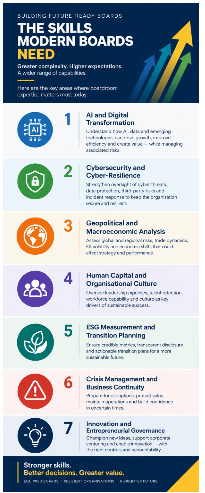
Skills matrices can help boards identify gaps between existing capabilities and those required to deliver the company’s three- to five-year strategy.

Targeted board refreshment can address those gaps, although renewal must be balanced with institutional knowledge. Experienced directors often possess a valuable understanding of the company’s history, stakeholders, and strategic context.

The Board of the Future

Continuous learning is therefore as important as board composition. Evaluations, scenario exercises and targeted education can strengthen directors’ understanding of emerging issues such as AI, cyber risk, ESG, crisis management and human capital.

For boards, these priorities are closely connected to the country’s operating environment. Economic volatility, foreign-exchange exposure, energy challenges, digital transformation, regulatory developments and changing expectations around sustainability all require informed oversight.

The evolution of the boardroom does not mean that directors should become executives. The distinction between governance and management remains fundamental.

The modern board’s responsibility is to provide effective oversight, informed challenges, strategic stewardship and accountability. Its effectiveness increasingly depends on whether directors have the skills and information needed to understand emerging risks, challenge management assumptions, and protect long-term corporate value.

For boards, the issue is therefore not whether traditional governance responsibilities remain relevant. They do. The issue is whether those responsibilities are being discharged with the skills, perspective, and foresight demanded by today’s business environment.

What do you think?
Leave a Reply

Your email address will not be published. Required fields are marked *

Read More

More Related News

Experience or Entrenchment? The Question Boards Must Confront

CACs New Disclosure Rules Signal a New Era of Corporate Accountability in Nigeria

Building Stakeholder Trust Through Accurate Corporate Records

Is approving a strategy enough for today’s board? How deeply should directors understand artificial intelligence, cybersecurity, and human capital? And how can boards respond to growing stakeholder demands without crossing the line between governance and management?

These questions are increasingly relevant to corporate governance. The traditional role of the board has centred on oversight, strategic direction, accountability and protection of shareholders’ interests. However, companies now operate in an environment shaped by economic volatility, geopolitical developments, technological disruption, cybersecurity threats, sustainability expectations and changing workforce dynamics.

Stakeholders increasingly expect boards to become active stewards of long-term corporate value. This does not mean that directors should manage the business. It means that boards must have the knowledge, information, and processes required to provide effective oversight of issues that can materially affect performance, resilience and reputation.

From Strategy Approval to Execution Oversight

One significant change is the growing expectation that boards should look beyond approving strategy to monitor its execution.

Directors are increasingly expected to test strategic assumptions, assess progress against objectives, consider alternative scenarios, and ensure that management responds when circumstances change.

This is particularly relevant to Nigerian companies, where foreign-exchange movements, inflation, interest rates, commodity prices, energy costs, and regulatory developments can rapidly alter business assumptions.

However, greater involvement must not become micromanagement. Management remains responsible for execution. The board’s responsibility is to provide oversight, challenge and direction while preserving clear executive accountability.

Resilience in an Uncertain Environment

Corporate resilience has also become a boardroom priority. Boards are expected to understand whether organisations have adequate contingency arrangements, liquidity resilience, supply chain alternatives, and crisis management procedures. Scenario planning can help directors assess how significant economic, operational or geopolitical shocks could affect the organisation.

While no board can predict every crisis, effective oversight requires directors to understand material vulnerabilities and ensure that credible response arrangements are in place.

AI and Digital Governance

Artificial intelligence is creating another important governance challenge. Boards increasingly need sufficient digital fluency to understand AI strategy, data governance, cybersecurity, model risk, ethical considerations, and value creation.

Not every director needs to be a technology specialist. However, boards need adequate collective expertise to challenge management and understand the risks associated with major digital investments.

As companies accelerate digital transformation, this capability becomes increasingly important. Technology opportunities must be considered alongside cybersecurity, data protection, third-party risks and business continuity.

ESG and Stakeholder Accountability

Stakeholder expectations around environmental, social and governance matters have also increased. Investors, regulators, employees and communities increasingly expect measurable outcomes rather than broad sustainability commitments. This places greater emphasis on credible metrics, disclosure, assurance and transition planning.

Boards also face increasing scrutiny over the relationship between sustainability performance and executive incentives.

At the same time, ESG oversight must remain connected to material business issues. Treating ESG simply as a reporting exercise can obscure its relevance to strategy, risk and long-term value.

Culture, Talent and Succession

Human capital is another area attracting greater board attention. Leadership succession, organisational culture, talent retention and workforce capability can directly affect strategic execution. Boards are therefore increasingly expected to review CEO and critical-role succession pipelines, culture indicators and significant retention risks.

Yet there remains an important boundary. Human-resource management is primarily an executive responsibility. The board should oversee human capital as a strategic risk without becoming involved in routine personnel management.

Closing the Boardroom Skills Gap

These expanding responsibilities raise a fundamental question: Does the board possess the capabilities the company will need in the future?

Traditional expertise in finance, accounting, law, and industry knowledge remains important. Increasingly, boards also require competence in:

Skills matrices can help boards identify gaps between existing capabilities and those required to deliver the company’s three- to five-year strategy.

Targeted board refreshment can address those gaps, although renewal must be balanced with institutional knowledge. Experienced directors often possess a valuable understanding of the company’s history, stakeholders, and strategic context.

The Board of the Future

Continuous learning is therefore as important as board composition. Evaluations, scenario exercises and targeted education can strengthen directors’ understanding of emerging issues such as AI, cyber risk, ESG, crisis management and human capital.

For boards, these priorities are closely connected to the country’s operating environment. Economic volatility, foreign-exchange exposure, energy challenges, digital transformation, regulatory developments and changing expectations around sustainability all require informed oversight.

The evolution of the boardroom does not mean that directors should become executives. The distinction between governance and management remains fundamental.

The modern board’s responsibility is to provide effective oversight, informed challenges, strategic stewardship and accountability. Its effectiveness increasingly depends on whether directors have the skills and information needed to understand emerging risks, challenge management assumptions, and protect long-term corporate value.

For boards, the issue is therefore not whether traditional governance responsibilities remain relevant. They do. The issue is whether those responsibilities are being discharged with the skills, perspective, and foresight demanded by today’s business environment.