
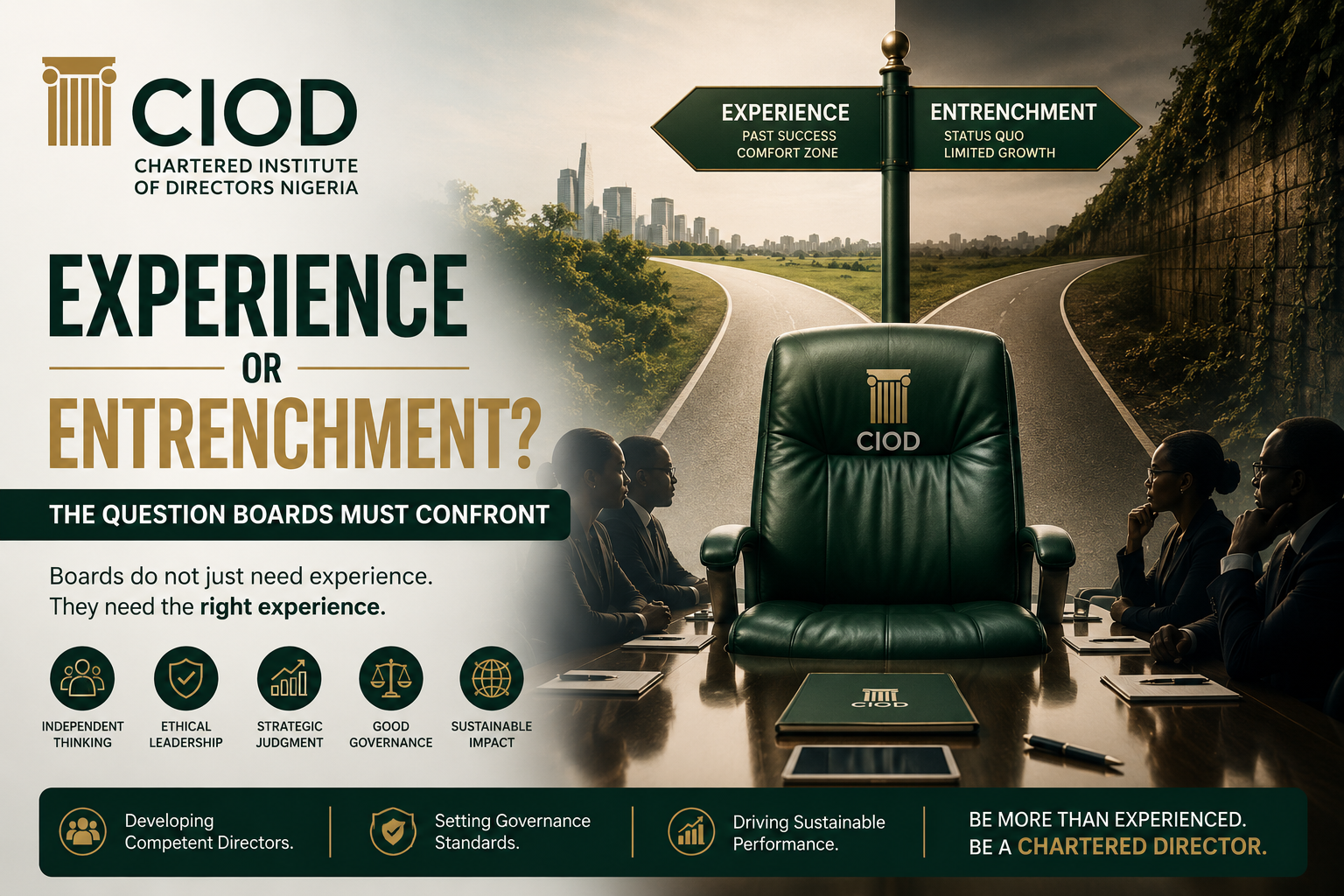
A recent governance decision by a major pan-African financial institution has brought an important question back into focus: how should companies balance the value of experienced directors with the need for Board renewal? The institution approved changes to its governance framework, reducing the maximum size of its Board while removing a fixed tenure cap for non-executive directors. The mandatory retirement age remains, and directors continue to be subject to shareholder election or re-election.
The rationale is understandable. Long-serving directors can preserve institutional memory, provide continuity and deepen the Board’s understanding of the organisation’s history, risks and strategic direction. Yet the same arrangement can raise another question: when does valuable experience become entrenchment?
This is not an argument for or against longer Board tenure. It is a question about how governance systems can preserve experience without allowing familiarity to weaken independence, challenge and accountability.
The Value of Experience
Experience is an important asset in the boardroom. Directors who have served through different economic cycles, leadership transitions, regulatory changes and corporate challenges can provide context that cannot easily be acquired from reports or short periods of service.
Institutional knowledge can help Boards understand why previous decisions were taken, what risks have materialised before and how the organisation has responded to periods of uncertainty. In complex businesses, particularly those operating across multiple markets, this continuity can be invaluable.
Board renewal, therefore, should not mean replacing experienced directors simply because they have served for a considerable period. A director’s longevity does not automatically make that director ineffective or compromised. The real issue is whether experience continues to translate into sound judgement, independent thinking and meaningful contribution.
When Experience Becomes Entrenchment
The other side of the debate is the possibility that prolonged tenure can create excessive familiarity. Directors who have worked together for many years may become comfortable with established practices, relationships and assumptions. Over time, this can potentially reduce the willingness to challenge management or question prevailing Board views.
Entrenchment does not necessarily arise because a director has deliberately acted improperly. It can develop gradually through familiarity, influence and institutional dependence.
This is why the question should not simply be, “How long has this director served?” A more meaningful question is, “Does this director still provide the level of independence, challenge and value that the Board requires?”
A Board can have highly experienced directors and still suffer from groupthink. Similarly, a newly constituted Board can lack the institutional knowledge required to make sound decisions. The governance challenge lies in finding the right balance.
What Does CAMA Tell Us?
Nigeria’s Companies and Allied Matters Act 2020 provides an important framework for considering this balance. CAMA does not impose a universal fixed tenure limit on all directors of public companies. Instead, it provides mechanisms through which Board accountability, independence, appointment, rotation, and removal can operate.
Section 275, for instance, as amended by the Business Facilitation Act (BFA) of 2023, requires public companies to have one-third independent directors and also establishes criteria for determining independence. This is significant because it recognises that effective governance requires more than simply having a Board; it requires directors capable of exercising independent judgement.
CAMA also provides shareholders with an important role in determining Board composition. Directors are subject to election and re-election by members, and the Act provides mechanisms for removing directors. Its provisions on rotation also introduce an element of Board renewal.
These provisions provide an important basis for the governance conversation. The law creates accountability mechanisms, but their existence does not, by itself, guarantee effective governance.
Legal Eligibility Is Not the Same as Board Effectiveness
A director may satisfy every legal requirement for continued service and still need to answer a more fundamental governance question: is continued service in the best interest of the company?
This distinction matters.
Corporate governance should not be reduced to whether a director is legally qualified to remain in office. Boards must also consider whether directors continue to contribute effectively, possess relevant skills, demonstrate sound judgement and exercise genuine independence.
This is where Board evaluation becomes critical. A robust evaluation process should examine not merely attendance but the quality of a director’s contribution, willingness to challenge management, participation in strategic discussions and ability to provide constructive dissent.
A director can satisfy formal requirements for independence while still facing the practical challenge of maintaining independent judgement. Independence is ultimately tested in moments of disagreement: when management’s proposal requires deeper scrutiny, when the majority holds a different view, or when asking difficult questions may be uncomfortable.
The real test of independence is therefore not simply whether a director can sit apart from management, but whether the director can think independently of management and the prevailing Board consensus.
This becomes particularly important where directors have served for extended periods. Rather than treating tenure as automatic evidence of compromised independence, Boards should assess whether long service has affected the director’s objectivity or capacity for constructive challenge.
Board Renewal Without Losing Institutional Memory
The debate should not be framed as experience versus renewal. Good governance requires both.
Too much turnover can deprive an organisation of institutional knowledge, while too little renewal can limit fresh thinking. A Board that never changes may struggle to incorporate new expertise in areas such as technology, cybersecurity, sustainability, geopolitical risk, or changing stakeholder expectations.
The objective should therefore be optimal renewal, not maximum turnover.
Boards should deliberately consider the skills and perspectives they will need in the future while preserving sufficient continuity to understand the organisation’s past.
This makes succession planning an essential governance responsibility. Board renewal should be planned rather than triggered only when a director reaches the end of a permitted tenure.
What Should Boards Evaluate?
Tenure should be considered alongside several other indicators. Boards should ask whether directors continue to make meaningful contributions, whether they provide constructive challenge and whether their expertise remains relevant to the company’s evolving strategic environment.
They should also examine whether the composition of the Board provides sufficient diversity of experience, skills and perspectives. Most importantly, Board evaluations should be sufficiently robust to identify when a director’s continued presence is adding value and when renewal may be necessary.
Shareholders also have an important role. Where directors are subject to re-election, shareholders must be able to make informed decisions about whether those directors should continue to serve.
The Governance Balancing Act
Ultimately, neither experience nor renewal should be treated as an absolute principle. A Board with excessive turnover may lose its institutional memory. A Board with insufficient renewal may risk stagnation. A director with long tenure may be a valuable source of wisdom and continuity, while another may have become overly comfortable with established relationships and practices.
The answer lies in governance systems capable of distinguishing between the two.
This means combining effective Board evaluations, meaningful shareholder oversight, succession planning, appropriate independence, diversity of perspectives, and a culture that encourages constructive challenge.
For Nigerian companies, the provisions of CAMA provide an important legal foundation, but the quality of governance will ultimately depend on how companies use these mechanisms. Compliance establishes the framework; Board culture and accountability determine what happens within it.
Five Questions Every Board Should Ask
As companies consider Board composition and director tenure, five questions deserve particular attention:
- Are our longest-serving directors still providing independent and constructive challenge?
- Are we retaining experience at the expense of fresh perspectives?
- Does our Board reflect the risks and opportunities the company faces today?
- Do Board evaluations genuinely influence succession and re-election decisions?
- Can we clearly demonstrate why each director’s continued service remains in the company’s best interest?
These questions shift the discussion from the simple measurement of tenure to the more important assessment of effectiveness.
Conclusion
The debate over director tenure is ultimately a debate about what Boards are expected to deliver. Experience matters because organisations benefit from institutional knowledge and continuity. Renewal matters because companies operate in environments that constantly change.
The challenge is to ensure that one does not undermine the other.
Good corporate governance should neither assume that long-serving directors are automatically entrenched nor that new directors are automatically better. Instead, it should create a system in which every director’s continued presence is justified by competence, independence, relevance, contribution and the ability to exercise sound judgement.
The question, therefore, is not simply whether experience is good or bad for governance. It is whether experience continues to strengthen the Board or has quietly become entrenchment. In the boardroom, experience should open the door, but continued effectiveness should be what keeps the seat.