
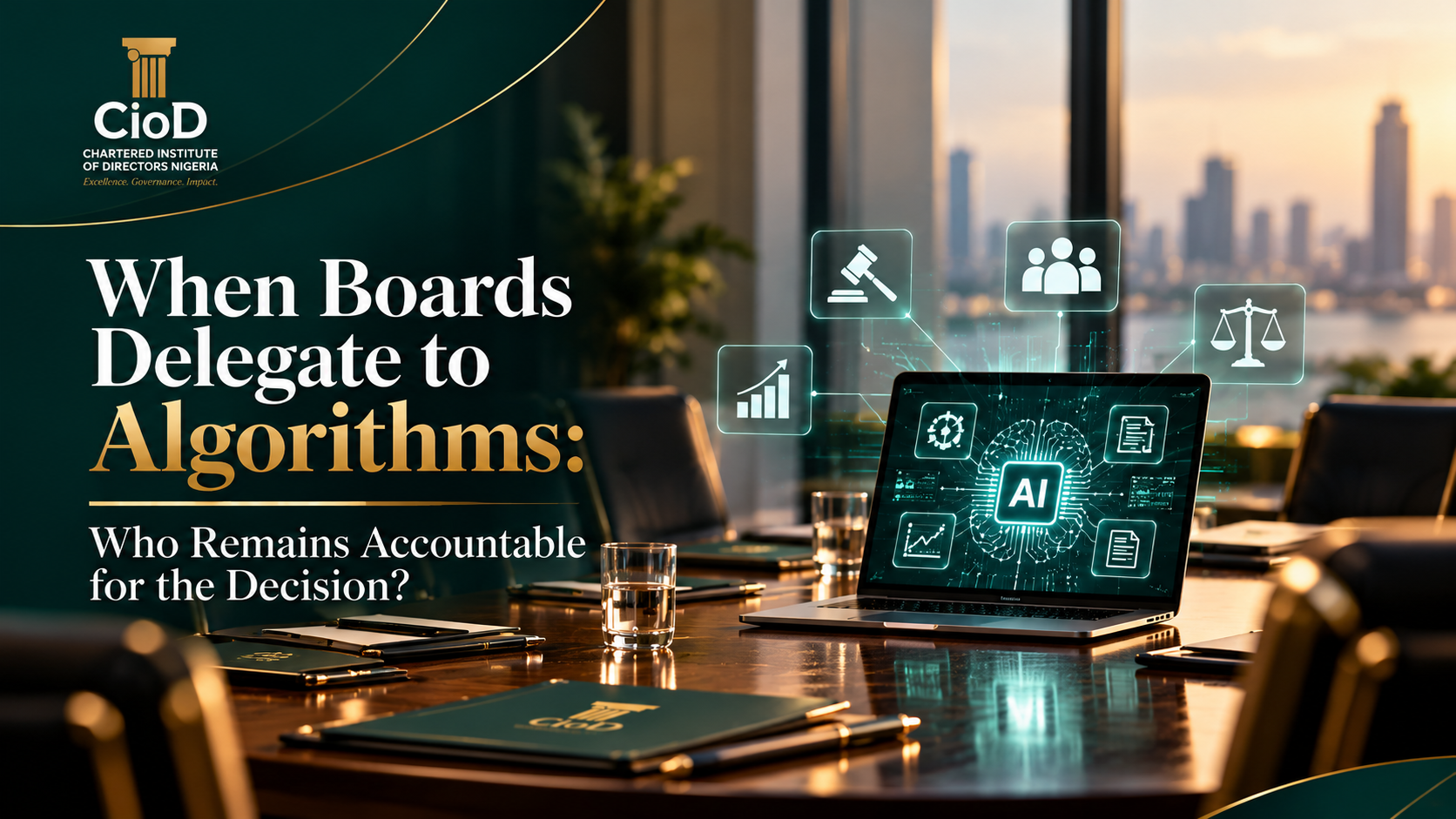
Artificial intelligence (AI) is changing how organisations assess risks, allocate resources, evaluate investments and make strategic decisions. From predictive analytics and automated financial forecasting to fraud detection and workforce planning, AI systems increasingly influence decisions that were once based primarily on human judgement.
For corporate boards, these developments offer opportunities to improve efficiency, strengthen risk assessment and support evidence-based decision-making. However, they also raise a fundamental governance question: when a corporate decision is informed by an algorithm, who remains accountable for its consequences?
The question is particularly important because corporate decisions carry legal, financial, ethical and reputational implications. Although AI can process information at a speed and scale that may exceed human capabilities, its recommendations are not necessarily accurate, impartial or appropriate for every situation.
Directors must therefore distinguish between using technology to support their judgement and allowing technological outputs to replace independent scrutiny. The central governance issue is not whether boards should adopt AI, but how they can benefit from its capabilities without weakening accountability.
The Growing Influence of Algorithms in the Boardroom
AI is no longer confined to routine administrative tasks. Organisations increasingly use it to analyse financial performance, forecast market conditions, identify emerging risks and support strategic planning.
These applications can help directors obtain timely information and examine scenarios that might otherwise be overlooked. When properly implemented, AI can improve the quality of information available to the board and support more informed deliberations.
Nevertheless, the usefulness of an AI-generated recommendation depends on the quality of the underlying data, the suitability of the model, and the assumptions that inform its output. A system trained on incomplete or historically biased data may produce misleading conclusions. Similarly, an algorithm designed to optimise short-term financial returns may fail to adequately account for long-term sustainability, employee welfare, or reputational exposure.
These limitations become governance concerns when directors accept recommendations without understanding their basis or testing their implications. A board that relies on AI without sufficient scrutiny risks replacing informed judgement with automated confidence. Technology should therefore strengthen the board’s capacity to question management, rather than become another authority that discourages challenge.
Board Accountability Cannot Be Delegated to an Algorithm
Corporate governance rests on clearly defined responsibilities, effective oversight and accountability for decisions. Under the Nigerian Code of Corporate Governance 2018, boards have responsibilities for strategic direction, risk management, internal controls, and organisational performance. These responsibilities remain relevant when companies introduce AI into their decision-making processes.
Delegating analysis to an AI system does not, by itself, transfer a director’s duties to the technology provider or software developer. The board must still exercise appropriate judgement, seek clarification where necessary and ensure that material decisions are supported by adequate information.
Management remains responsible for implementing approved strategies and operating within established controls, while the board must oversee management and challenge decisions where the circumstances warrant it.
Consider a company whose AI system recommends closing a business unit based on projected losses. The recommendation may appear financially justified, but directors must consider the reliability of the projections, the underlying assumptions, the costs of closure, the impact on employees and customers, and the long-term implications for the organisation. Accepting the recommendation without examining these factors would undermine the purpose of board oversight.
Accountability does not require directors to personally understand every technical detail of an AI model. It means that they must obtain sufficient assurance about its suitability, limitations and risks to make informed decisions. Where specialist knowledge is required, boards should seek independent expertise rather than treat technical complexity as grounds for surrendering oversight.
The Governance Risks Behind Algorithmic Decisions
Several risks require particular attention as AI becomes more deeply integrated into corporate decision-making.
- Algorithmic bias: AI systems may reproduce discriminatory patterns embedded in their training data. In recruitment, lending or customer assessment, this may result in decisions that disadvantage particular groups. Boards must ensure that appropriate safeguards are in place to identify and address unfair outcomes.
- Limited explainability: Some AI systems produce recommendations that are difficult for non-specialists to interpret. When directors cannot establish why a system has reached a particular conclusion, their ability to challenge assumptions and assess risks may be weakened. Organisations must therefore require explanations and supporting evidence proportionate to the significance of the decisions involved.
- Data protection and cybersecurity: AI applications may process confidential business information, employee records and customer data. Inadequate safeguards can expose organisations to data breaches, regulatory sanctions and reputational damage. Nigeria’s Data Protection Act 2023 reinforces the importance of lawful and responsible personal data processing. Boards should ensure that AI adoption is consistent with applicable data protection and cybersecurity obligations.
- Automation bias: Directors and executives may place excessive confidence in computer-generated recommendations, particularly when the outputs appear precise or technically sophisticated. This can discourage independent analysis and cause warning signs to be overlooked. Effective governance requires human judgement to remain an active part of material decision-making.
The Regulatory and Governance Imperative
Existing corporate governance principles provide a foundation for overseeing AI, even when they do not explicitly address every technological development. The Nigerian Code of Corporate Governance 2018 emphasises effective leadership, risk management, internal controls and accountability. These principles can inform board oversight of AI-related risks and opportunities.
International guidance also offers useful reference points. The OECD AI Principles promote trustworthy AI, transparency, accountability, and respect for human rights, while the National Institute of Standards and Technology’s AI Risk Management Framework provides guidance on identifying, assessing, and managing AI-related risks.
These instruments do not all carry the same legal status. Boards must distinguish between applicable legal requirements, sector-specific regulations and voluntary guidance. Nevertheless, together they demonstrate the importance of integrating AI oversight into established governance arrangements rather than treating it solely as a technical matter for information technology departments.
Practical Steps for Effective Board Oversight
Boards should begin by establishing a clear understanding of how AI is used across their organisations. This includes identifying systems that influence material financial, operational, employment and strategic decisions. Without this visibility, directors may be unable to assess the full extent of the organisation’s exposure.
Clear responsibilities are equally important. Management should establish appropriate procedures for selecting, testing and monitoring AI systems, while the board should determine how material risks are reported and escalated. Responsibility for approving significant AI-related decisions should be explicit, with adequate documentation of the evidence considered and the reasons for the final decision.
Boards should also require proportionate testing of AI systems for accuracy, reliability, bias and security. Independent assurance may be necessary where a system affects critical business operations or high-impact decisions. Internal audit can contribute by examining whether relevant controls are operating effectively and whether management is complying with approved policies.
Director education is another priority. Board members do not need to become software engineers, but they should understand the principal capabilities, limitations and risks of the systems used by their organisations. Where internal expertise is insufficient, external specialists can help directors assess complex technical issues without compromising their independence.
Finally, organisations should establish procedures for reporting AI-related errors, investigating adverse outcomes and correcting defective systems. The objective is not to eliminate every possibility of error, which may be unrealistic, but to ensure that risks are identified early, responsibilities are clear and appropriate corrective action can be taken.
Conclusion
The growing influence of artificial intelligence in corporate decision-making requires boards to reconsider how they exercise oversight without abandoning established governance principles. AI can strengthen analysis, improve forecasting and support strategic decisions, but its outputs remain dependent on data quality, system design and the circumstances in which they are applied.
The responsibility of directors is therefore not to reject algorithmic assistance, but to ensure that it operates within appropriate governance arrangements. This requires clear accountability, informed human judgement, effective internal controls and continuous assessment of technological risks.
Ultimately, an algorithm may recommend a decision, but it cannot relieve a board of its applicable responsibilities. The quality of corporate governance will depend not simply on how effectively organisations deploy AI, but on whether directors retain the capacity to question its recommendations, understand its limitations and remain accountable for the decisions made in the organisation’s name.