
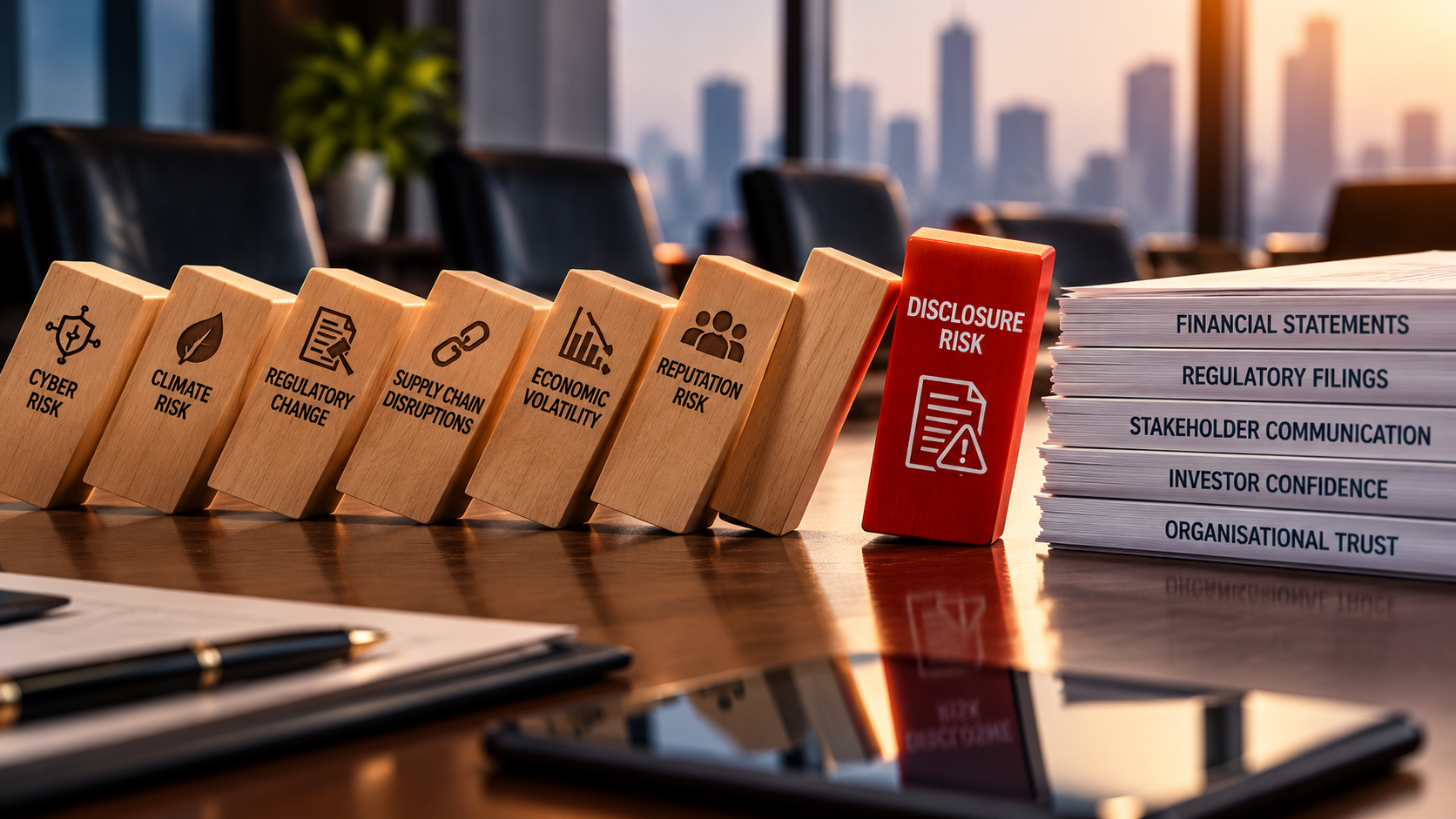
Corporate risks are no longer confined to familiar areas such as financial performance, liquidity, credit, operations, and compliance. Artificial intelligence, geopolitical tensions, regulatory changes, cybersecurity, data protection, and technological disruption are creating new risks that can affect a company’s operations, reputation, and value. For boards, the challenge is no longer simply identifying these risks. It is also deciding when an emerging risk becomes material enough to require disclosure to investors.
This issue came into focus in September 2026 following reports of a securities class action against a major technology company. The lawsuit alleges that the company and certain executives made materially false or misleading statements and failed to disclose adverse information relating to its business, operations, and prospects. Among the allegations were issues concerning regulatory classification and the alleged use of artificial intelligence technology. These remain allegations in a pending legal proceeding and should not be treated as established findings (PR Newswire – Alibaba Securities Fraud Lawsuit)
The case nevertheless raises an important corporate governance question: when does an emerging business risk become a disclosure responsibility for the board? An emerging risk is a new or developing threat that may affect an organisation but whose full consequences may not yet be clear. Artificial intelligence provides a good example. A company may use AI to improve productivity, develop products or compete in new markets. At the same time, it may face risks related to data, intellectual property, cybersecurity, regulation, model reliability, or the misuse of technology.
The existence of a risk does not automatically mean that it must be disclosed to investors. The important question is whether the risk could reasonably affect the company’s business, financial condition, operations, prospects or value. This requires boards to pay attention to materiality. A risk that initially appears remote may become material as new information emerges. Similarly, a technological or regulatory issue that management initially regards as an operational matter may eventually become relevant to investors.
The board should therefore ask not only, “Do we have this risk?” but also, “If investors knew about this risk, could it affect their assessment of the company?” The Board’s Responsibility Does Not End With Risk Identification
The board has an important responsibility to oversee the company’s risk management and ensure that material matters receive proper attention. The Nigerian Code of Corporate Governance 2018 contains a dedicated section on risk management and places risk oversight within the responsibilities of the board and its committees (FRC Nigeria).
This means that emerging risks should not remain solely within management reports. Where a risk could materially affect the company’s operations or prospects, directors should have sufficient information to question management’s assessment and understand how the risk is being managed.
Effective board oversight requires directors to ask difficult questions. What has changed? How could the risk affect the company? What assumptions support management’s assessment? Is the risk already reflected in public disclosures? Has new information made previous disclosures incomplete or outdated? These questions become particularly important where the company operates in sectors exposed to rapid technological or regulatory change.
Disclosure Requires More Than Technical Compliance
Corporate disclosure is not simply a matter of producing annual reports and regulatory filings. Investors depend on information provided by companies to understand their prospects and the risks associated with their investment.
The SEC’s corporate governance guidance requires public companies in Nigeria to comply with the NCCG 2018 and the SEC Corporate Governance Guidelines, with the stated objective of strengthening transparency, accountability and good corporate governance (SEC Nigeria).
A board, therefore, needs processes that connect risk management with financial and corporate reporting. A risk identified within the organisation should be assessed to determine whether it has implications for information already provided to investors.
This is particularly important when circumstances change rapidly. A disclosure that was accurate six months ago may no longer provide a complete picture if new regulatory, technological or commercial developments have occurred.
Artificial Intelligence Creates a New Governance Challenge
AI makes this issue particularly relevant. Companies are increasingly using AI in areas ranging from customer service and product development to financial analysis and decision-making. At the same time, AI can introduce risks that may be unfamiliar to directors.
These can include data privacy concerns, intellectual property disputes, cybersecurity threats, inaccurate outputs, regulatory uncertainty, and reputational damage.
The board does not need to become a technical expert in every AI system used by the company. It does, however, need to understand the major risks associated with the technology and the systems in place to manage them.
The board should also know who is responsible for monitoring these risks, how incidents are escalated, and whether material developments could affect information already provided to shareholders.
From Reactive Disclosure to Active Oversight
One of the dangers facing boards is a reactive approach to emerging risks. Under such an approach, a company identifies a risk only after an event has occurred, followed by an assessment of whether disclosure is necessary.
A stronger governance process begins earlier. Management should identify emerging risks, assess their possible effects, report material matters to the board and continuously review whether circumstances have changed.
This approach also requires consistency. What management tells the board about a company’s risks should not materially conflict with what the company communicates to shareholders and the wider market.
Directors can strengthen their oversight of emerging risks by regularly asking
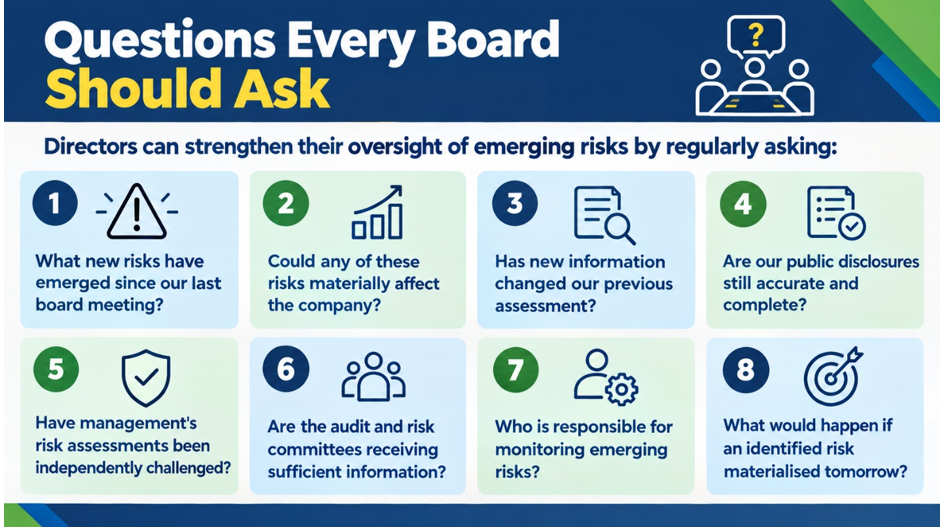
These questions can help boards move from simply receiving risk reports to actively overseeing how risks are identified, assessed and communicated.
The increasing importance of technology, geopolitical developments, regulation and other emerging risks means that boards need to look beyond traditional risk categories. A risk may begin as an operational concern but become a corporate disclosure issue when it has the potential to affect a company’s business, prospects, or value.
The recent securities lawsuit discussed in September 2026 reminds us of the connection between risk oversight, disclosure, and board accountability. The allegations in that case remain subject to legal proceedings, but the governance lesson is broader: boards should have reliable processes for identifying material risks and determining whether investors have been given appropriate information about them.
For Nigerian boards, the message is clear. Good governance requires more than responding when a risk becomes a crisis. Directors need to ensure that emerging risks receive proper attention, that management is challenged where necessary, and that corporate disclosures continue to reflect material developments. Transparent disclosure is therefore not merely a reporting exercise. It is an important expression of board accountability to shareholders and other stakeholders.